
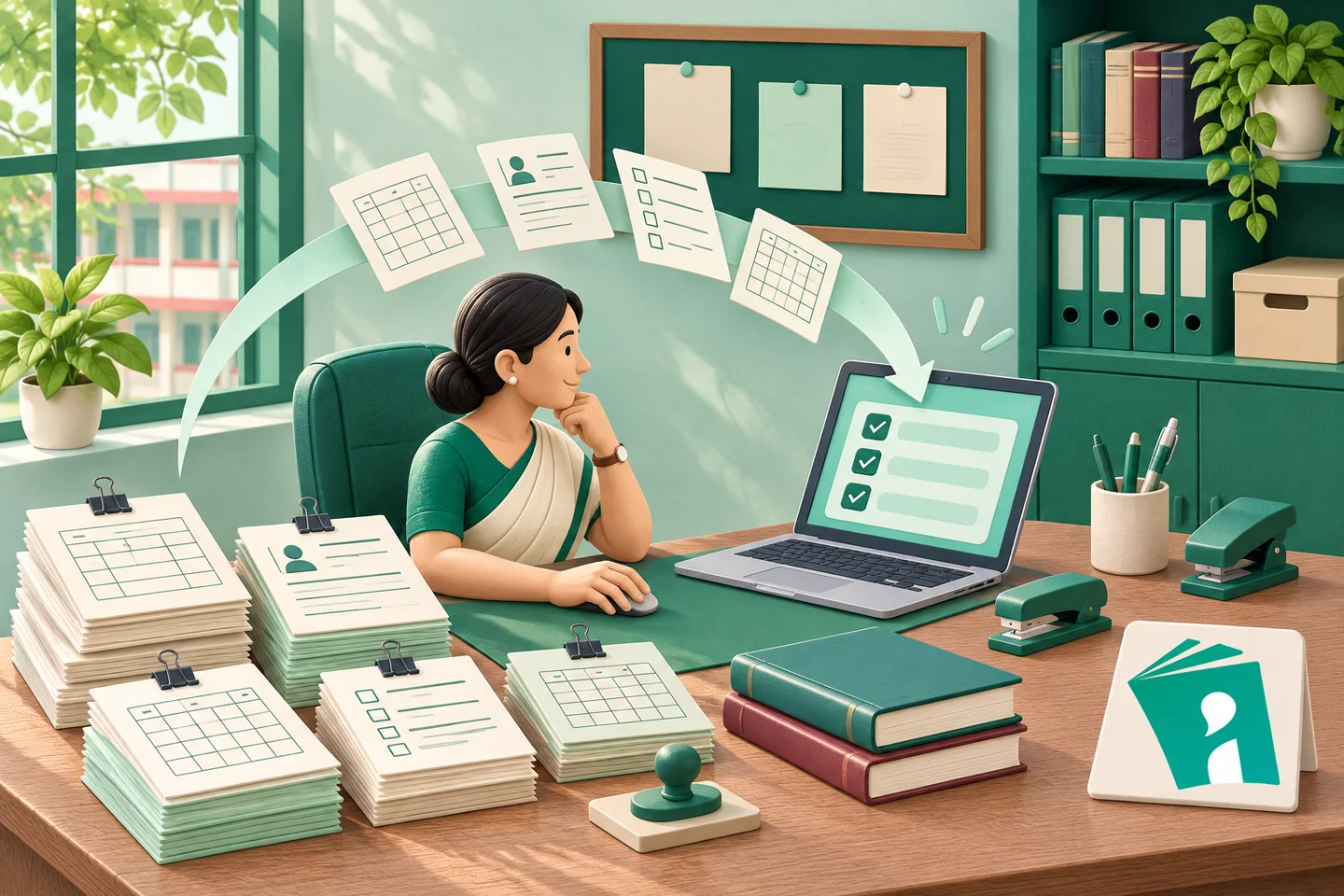
Start with work that repeats student details, recalculates the same totals or requires staff to search several records. A maintained source for student identities, class lists, attendance and reports can reduce repeated entry. Do not assume it replaces original documents or signed records required by your institution’s policy.
The aim is to identify unnecessary repetition in a specific workflow. Trying to remove every paper record at once can obscure the actual problem.
Map where one record travels
A student’s name might be entered in an admission register, class list, fee record and examination list. Correcting a spelling then requires several changes. Identify which record should be the source and which outputs should use that identity.
| Current work | Repetition | What to test |
|---|---|---|
| Admission | The same name is entered repeatedly | Necessary lists use one student ID |
| Class list | Old files are copied and edited | The roster identifies its correct session |
| Attendance summary | Staff count daily entries again | Saved registers support the summary |
| Fee review | Receipts are searched across registers | Relevant invoices and payments can be traced |
| Monthly meeting | Separate files are manually reconciled | Time periods and definitions agree |
This is a fictional workflow example. Understand your existing work before planning a complete change.
Begin with a small, well-defined problem
Choose work with a clear owner and expected result. Clean a small sample of existing records, test the new process and compare the results. Decide which source is authoritative during the trial so that independent changes do not silently create conflicting versions.
Measure the actual change
Record repeated entries, corrections and records that staff could not find. If you measure time, compare similar work under comparable conditions. Do not promise a percentage saving without evidence from the institution. Initial training and record cleanup also take time.
Reconcile the old and new records
Agree the trial period, review responsibility and retention of necessary originals. A useful readiness discussion covers:
- Which records must move to the new workflow?
- Which originals still need to be retained?
- Who authorizes corrections?
- Where is temporary work kept during an interruption?
- Who confirms that the pilot produced acceptable results?
Use the paper-to-digital preparation guide to structure the discussion. Compare student management and reporting with your own task map.
Frequently asked questions
Will buying software eliminate every paper record?
No. Follow applicable institutional requirements for originals and signatures. Evaluate repeated work separately from required document retention.
Must all historical information be moved immediately?
Define the scope according to operational needs and approved retention rules. A small sample of essential current records can help establish the migration method.
How much time will we save in the first month?
That requires measurement in your institution. Include training and cleanup when assessing the initial workload rather than assuming immediate savings.
Bring a blank example of one repeated task to an iilmaa workflow demo.